English| EUR
Suggested for you
More currencies
Choose a language
The Spanish Riding School stages classical dressage performances featuring Lipizzaner stallions in Vienna's Hofburg Palace. This guide covers performance schedules, the institution's equestrian legacy, and practical logistics for attending a show or tour.
Quick answer
The Spanish Riding School presents Lipizzaner horse shows at Michaelerplatz 1, with the facility open daily from 09:00 to 16:00. Performance tickets start at 17 EUR, though prices vary by program type and seating category. Morning training sessions and formal gala performances follow different schedules throughout the year, so checking the official calendar before your visit ensures you catch the experience that matches your interest.
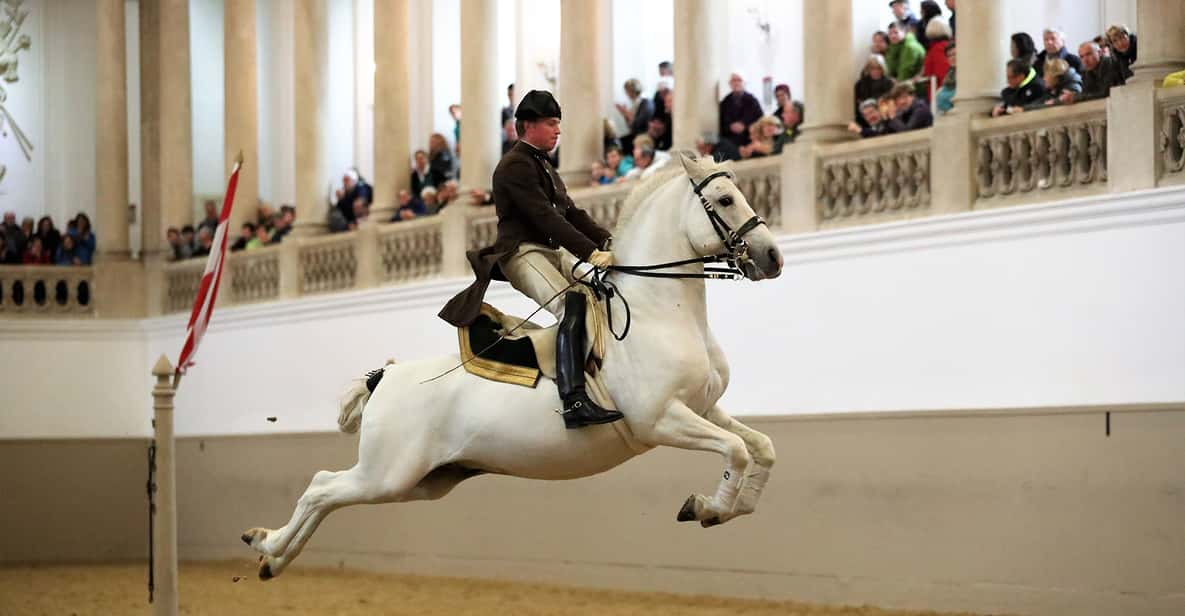
Every Lipizzaner stallion performing at the Spanish Riding School descends from six founding bloodlines established in the 16th century, making each performance a living record of Europe's oldest breeding program. The white coats synonymous with the breed don't appear until the horses reach maturity—foals are born dark gray or bay. The lipizzaner horse show vienna unfolds in the Winter Riding School, a baroque hall commissioned by Emperor Charles VI in 1735. Chandeliers hang above sand riding surfaces where riders in bicorne hats and tailcoats guide stallions through movements choreographed four centuries ago. The architecture itself—white columns, dual-level galleries, natural light from tall windows—was designed to showcase equestrian skill, not spectator comfort, so audiences watch from wooden benches that prioritize sightlines over padding. Three distinct program formats serve different visitor interests. Morning training sessions run Tuesday through Saturday and offer unnarrated glimpses of daily work routines. Classical performances, staged on weekends and select weekday evenings, present full choreography with musical accompaniment. Gala events add costume changes and theatrical lighting. Choosing a format depends on whether you value informal access or polished presentation, and whether narration matters to your understanding of what centuries of selective breeding and rider training produce. The stallions master movements—the levade, capriole, courbette—that originated as battlefield maneuvers when cavalry needed horses capable of sudden vertical power. Modern performances preserve those techniques as cultural heritage rather than military application. Riders train for years before performing publicly, and each horse's career spans decades, creating partnerships visible in the precision of synchronized movements. Vienna's Hofburg location situates the school within walking distance of the city's imperial quarter, where the same Habsburg patronage that funded the riding hall also built the surrounding palaces and museums. Arriving during the recommended 09:00–10:00 window allows time to navigate the entrance at Michaelerplatz and settle before performances begin, particularly important since late entry disrupts both horses and audience.
“Every Lipizzaner stallion performing at the Spanish Riding School descends from six founding bloodlines established in the 16th century, making each performance a living record of Europe's oldest breeding program.”
The Spanish Riding School visitor center and facilities remain open daily to accommodate guests interested in the Lipizzaner horse training and performances.
The cost of attending the Lipizzaner horse show at the Spanish Riding School depends on the specific performance program and the selected seating category. Entrance fees reflect the variety of events offered throughout the season.
Verdict: Tickets start at 17 EUR, with final prices determined by the specific program chosen and the seating category selected.
The Spanish Riding School is located at Michaelerplatz 1, 1010 Wien, Austria, within the Hofburg Palace complex. The site is centrally situated and accessible via various modes of public transportation.
U3 line to Herrengasse station
1A or 2A bus lines to Michaelerplatz
Parking is available in nearby public garages
The best arrival window is 09:00–10:00. Arriving during this period helps visitors avoid peak crowds and ensures timely entry for scheduled performances or tours.
The Spanish Riding School traces its origins to 1565, when Habsburg Archduke Charles II established a court stud at Lipizza near Trieste to breed horses for the imperial household. Emperor Maximilian II had already founded a riding academy in Vienna, creating the institutional foundation. The Lipizzaner breed emerged from Andalusian, Barb, and Italian bloodlines, refined over generations to produce the white stallions synonymous with classical dressage. The lipizzaner horse show vienna became formalized in 1735 when Emperor Charles VI commissioned the Winter Riding School at the Hofburg Palace, designed by architect Joseph Emanuel Fischer von Erlach. This baroque hall, with its white columns and chandeliers, remains the performance venue today. The Napoleonic Wars and both World Wars threatened the breed's survival. In 1809, French troops occupied Vienna and used the riding hall as a storage depot. World War II brought the most severe crisis: the Lipizzaner stud was evacuated to Czechoslovakia in 1942, then moved again as Soviet forces advanced. General George S. Patton authorized Operation Cowboy in 1945, rescuing the herd and returning it to Austria. Cold War division initially separated the Vienna school from its Lipizza breeding grounds, now in Yugoslavia. The school adapted by sourcing stallions from Piber in Styria, established as the primary stud in 1920. Post-war decades saw the Spanish Riding School transition from imperial institution to cultural heritage site. UNESCO inscribed the tradition on its Representative List of the Intangible Cultural Heritage of Humanity in 2015, recognizing classical equitation as a living practice spanning four centuries. Performances of the Viennese Lipizzaner tradition now welcome international audiences year-round. Visitors entering the Winter Riding School still see the portrait of Charles VI above the balcony, the original chandeliers, and the same sand arena where stallions execute movements codified in the Renaissance.
Archduke Charles II establishes the court stud at Lipizza to breed horses for the Habsburg imperial household.
Emperor Charles VI commissions the Winter Riding School at the Hofburg Palace, designed by Joseph Emanuel Fischer von Erlach.
French occupation forces under Napoleon use the riding hall as a storage depot during the invasion of Vienna.
The Piber stud in Styria is established as Austria's primary breeding facility for Lipizzaner stallions.
General George S. Patton authorizes Operation Cowboy to rescue the Lipizzaner herd from advancing Soviet forces in Czechoslovakia.
UNESCO inscribes the Spanish Riding School and its classical equitation tradition on the Representative List of Intangible Cultural Heritage.
Enhance your experience at the Spanish Riding School by following these practical observations regarding performance etiquette and venue environment.
The winter riding school maintains a historic environment where smart-casual attire is standard for visitors. Avoid bulky outerwear to remain comfortable throughout the performance duration as seating areas can be compact.
Strictly observe the ban on photography and video recording during performances to respect the riders and the concentration of the stallions. Use your eyes to focus on the technical precision of the movements rather than your screen.
The venue is a historic indoor structure that can remain cool even during warmer months. Bringing a light layer ensures you stay comfortable while watching the training or performance sessions.
Minimal noise and sudden movements help maintain the calm necessary for the horses during their intricate routines. Refrain from talking or moving in your seat during the performance to ensure a respectful environment for the riders.
Arriving during your recommended window helps you find your specific section without causing disruption to others. Check your seating assignment beforehand to move efficiently through the historic hallways toward your designated area.
Everything you need to know about lipizzaner horse show vienna
The lipizzaner horse show vienna is a classical equestrian performance held at the historic Spanish Riding School. It features the precise movements and training of world-renowned Lipizzaner stallions in a traditional setting.
Entrance fee for these events starts at 17 EUR, though costs vary by program and seating category. You should check the official site for specific event pricing and availability.
For the best experience, arrive between 09:00–10:00 to avoid peak crowds and ensure timely entry for your scheduled performance. This arrival window helps you settle in before the exhibition begins.
Children are generally welcome to witness the equestrian tradition, provided they are old enough to sit quietly through the performance. Please check the specific event details on the official site regarding age recommendations.
A visit to see the stallions typically lasts a few hours depending on the chosen program type. It is recommended to plan your day around your scheduled entry time to fully enjoy the historic atmosphere.
The venue is located at Michaelerplatz 1, 1010 Wien, Austria. This central location in the city is accessible via public transportation and is a prominent landmark.
Official tickets for the lipizzaner horse show vienna are available directly through the Spanish Riding School website. Using the official portal ensures you receive valid entry for your chosen date and time.